
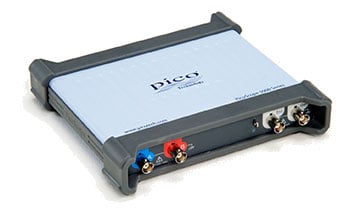
PICO PicoScope 5242D MSO Oscilloscopes (2-channel, 60 MHz)
Channel: 2
Oscilloscope - vertical
Input type:: Single-ended, BNC connector
Bandwidth (–3 dB): 60 MHz
Rise time (calculated): 5.8 ns
Bandwidth limiter: 20 MHz, selectable
Vertical resolution: 8, 12, 14, 15 or 16 bits
LSB size[2] (quantization step size): 8 bit mode: < 0.6% of input range
• 12 bit mode: < 0.04% of input range
• 14 bit mode: < 0.01% of input range
• 15 bit mode: < 0.005% of input range
• 16 bit mode: < 0.0025% of input range
Enhanced vertical resolution: Hardware resolution + 4 bits
Input ranges: ±10 mV to ±20 V full scale, in 11 ranges
Input sensitivity: 2 mV/div to 4 V/div (10 vertical divisions)
Input coupling: AC / DC
Input characteristics: 1 MΩ ± 1% || 14 ±1 pF
Gain accuracy:
• 12 to 16 bit modes: ±0.5% of signal ±1 LSB
• 8 bit mode: ±2% of signal ±1 LSB
Offset accuracy: ±500 µV ±1% of full scale; Offset accuracy can be improved by using the “zero offset” function in PicoScope software.
Analog offset range (vertical position adjust):
• ±250 mV (10, 20, 50, 100, 200 mV ranges),
• ±2.5 V (500 mV, 1 V, 2 V ranges),
• ±20 V (5, 10, 20 V ranges)
Analog offset control accuracy: ±0.5% of offset setting, additional to basic DC offset accuracy
Overvoltage protection: ±100 V (DC + AC peak)
Vertical (digital channels)
Input channels: 16 channels (2 ports of 8 channels each)
Input connector: 2.54 mm pitch, 10 x 2 way connector
Maximum input frequency: 100 MHz (200 Mbit/s)
Minimum detectable pulse width: 5 ns
Input impedance: 200 kΩ ±2% || 8 pF ±2 pF
Input dynamic range: ±20 V
Threshold range: ±5 V
Threshold grouping: Two independent threshold controls. Port 0: D0 to D7, Port 1: D8 to D15
Threshold selection: TTL, CMOS, ECL, PECL, user-defined
Threshold accuracy: < ±350 mV including hysteresis
Threshold hysteresis: < ±250 mV
Minimum input voltage swing: 500 mV peak to peak
Channel-to-channel skew: 2 ns, typical
Minimum input slew rate: 10 V/µs
Overvoltage protection: ±50 V (DC + AC peak)
Triggering (main specifications)
Source: Analog channels, plus: Digital D0 to D15. Other models: Ext trigger.
Trigger modes: None, auto, repeat, single, rapid (segmented memory).
Advanced trigger types (analog channels): Edge, window, pulse width, window pulse width, dropout, window dropout, interval, runt, logic.
Trigger types (analog channels, ETS): Rising or falling edge ETS trigger available on ChA only, 8-bit mode only.
Trigger sensitivity (analog channels): Digital triggering provides 1 LSB accuracy up to full bandwidth of scope.
Trigger sensitivity (analog channels, ETS): At full bandwidth: typical 10 mV peak to peak
Trigger types (digital inputs): Edge, pulse width, dropout, interval, logic, pattern, mixed signal.
Maximum pre-trigger capture: Up to 100% of capture size.
Maximum post-trigger delay: Zero to 4 billion samples, settable in 1 sample steps (delay range on fastest timebase of 0 – 4 s in 1 ns steps)
Trigger rearm time:
• 8-bit mode, typical: 1 μs on fastest timebase
• 8 to 12 bit modes: < 2 μs max on fastest timebase
• 14 to 16 bit modes: < 3 μs max on fastest timebase
Maximum trigger rate: 10 000 waveforms in a 10 ms burst, 8-bit mode
Get exclusive volume discounts, bulk pricing updates, and new product alerts delivered directly to your inbox.
By subscribing, you agree to our Terms of Service and Privacy Policy.
Direct access to our certified experts