Pipe inspection camera are often considered simple tools for viewing the inside of pipelines. As long as the image is sharp, the LED lighting is bright enough, and the cable is long enough, many assume that any issue inside the pipe can be detected easily. In reality, however, technicians still frequently misidentify leak locations, overlook small cracks, or incorrectly assess the severity of damage even when the camera is operating normally and the displayed image appears perfectly clear. Below are some of the most common mistakes encountered during inspections.
Brighter Images Is Not Always Mean More Effective Inspections
Increasing LED brightness to the maximum level is a very common practice when inspecting dark or water-filled pipelines. While this approach may seem reasonable, it can actually reduce inspection accuracy inside metal pipes, damp PVC pipes, or areas containing standing water.
Strong reflections from the pipe surface can create localized glare on the camera lens, causing fine cracks or thin layers of corrosion to almost disappear from the display.
This issue is especially common around pipe joints or highly reflective surfaces. The image may still appear sharp, but the most critical details can easily become hidden behind reflective hotspots.
For this reason, experienced technicians often reduce LED intensity instead of maximizing it, while also adjusting the camera angle to minimize direct reflections.
Damaged sections are often located outside the camera’s angle.
When using a pipe inspection camera, operators usually focus on the area directly in front of the camera probe. In real pipeline systems, however, damaged sections are often located outside the camera’s immediate viewing angle.
Small cracks are often found behind joints, along curved sections, or underneath the pipe surface. With conventional fixed-head cameras, technicians can only view part of the internal pipe wall at a time. As a result, important defects may easily be overlooked even when the camera passes directly through the damaged area.
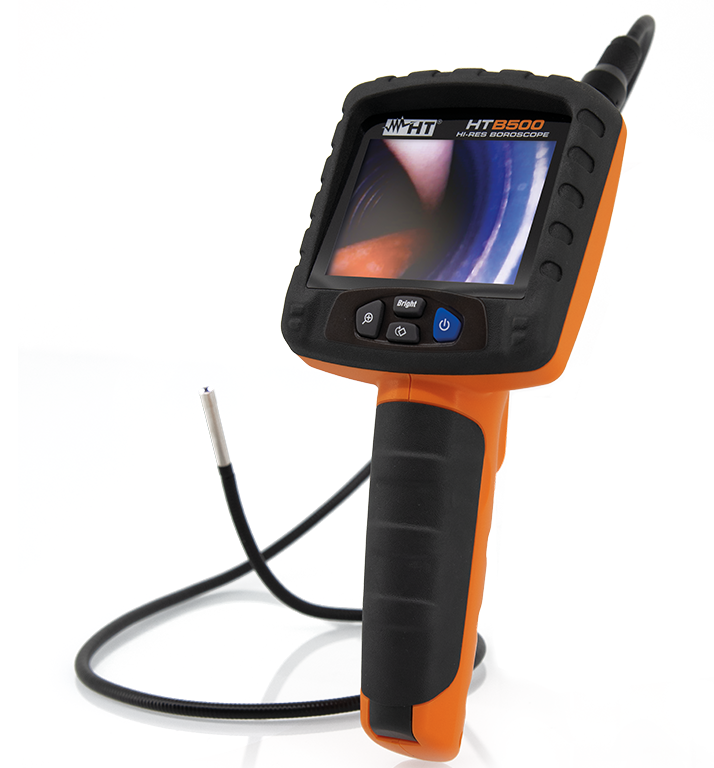
This is one reason why articulating and self-leveling inspection cameras are becoming increasingly common in industrial maintenance and HVAC inspections. Their main advantage is not higher resolution, but the ability to change viewing angles inside confined spaces a factor that directly affects real-world defect detection.
Overly Flexible Cables Can Lead to Incorrect Inspection Results
Cable length is often the first specification users pay attention to when selecting a pipe inspection camera. However, the mechanical stiffness of the push cable has a major influence on inspection accuracy.
Inside long pipelines or systems with multiple bends, excessively flexible cables can twist or coil before the camera head reaches the intended inspection point.
In these situations, technicians may believe the camera has advanced deep into the pipeline while the probe is actually rotating within a curved section of pipe.
This type of positioning error becomes particularly problematic in concealed wall systems or underground pipelines because it can lead to incorrect repair locations. In some cases, multiple sections must be opened simply because the camera never actually reached the suspected area.
In large industrial systems, technicians typically select cable stiffness based on pipe diameter and the number of bends rather than simply choosing the longest cable available.
Condensation Is One of the Biggest Challenges for Inspection Cameras
Waterproof ratings such as IP67 or IP68 are often considered important when choosing a waterproof inspection camera. In real operating environments, however, moisture and temperature differences create far greater inspection difficulties.
When a videoscope inspection moves from an outside environment into a hot or humid pipeline, condensation may form on the lens surface. Even a thin layer of fog can significantly reduce image contrast, making small cracks or corrosion signs extremely difficult to identify. This issue is often mistaken for poor sensor quality or insufficient image resolution, leading users to replace the camera with a higher-resolution model without seeing meaningful improvement.
In HVAC systems, steam pipelines, or enclosed industrial piping, anti-fog performance can sometimes be more important than display resolution itself.
Inspection Cameras Cannot Fully Replace The Experience Technician
Borescope only provide visual information. Determining whether a mark is a harmless deposit, a serious corrosion issue, or an early-stage crack still depends heavily on the operator’s technical experience.
In many situations, a very slight change in surface color or light reflection may already indicate internal pipe deterioration. These details can be difficult to recognize through casual observation alone.
This is why many maintenance teams combine inspection cameras with data logger to detect abnormalities earlier than major failure occurs. This approach helps reduce downtime, minimizes unnecessary demolition work, and prevents damage from spreading throughout the system.